- R GENERATION
- Posts
- ☕️ (R)emote Expresso #59
☕️ (R)emote Expresso #59
Not Okay, Still Here: What If You Stopped Pretending?

Deb Haas
January 20, 2026 • ⏰ Reading Time: 18 minutes
☕️ (R)emote Expresso is your weekly dose of creator insights on remote collaboration designed to fuel your day, delivered once a week in your inbox 💌

Hey Remote Rebels and Digital Daydreamers,
I'm writing this from Minneapolis. ICE raids - part of "Operation Metro Surge" - have been escalating here since December. Thousands of federal agents. My city feels occupied. My nervous system is louder than my to-do list. And I still have a newsletter deadline.
So here's the truth: I'm not okay. And I'm still here.
If you're reading this and thinking "same, but different reason" - you're exactly who this is for.
Because here's what nobody tells you about remote work: you can't collaborate effectively when you're spending half your energy pretending you're fine.
The performance costs more than the honesty ever would.

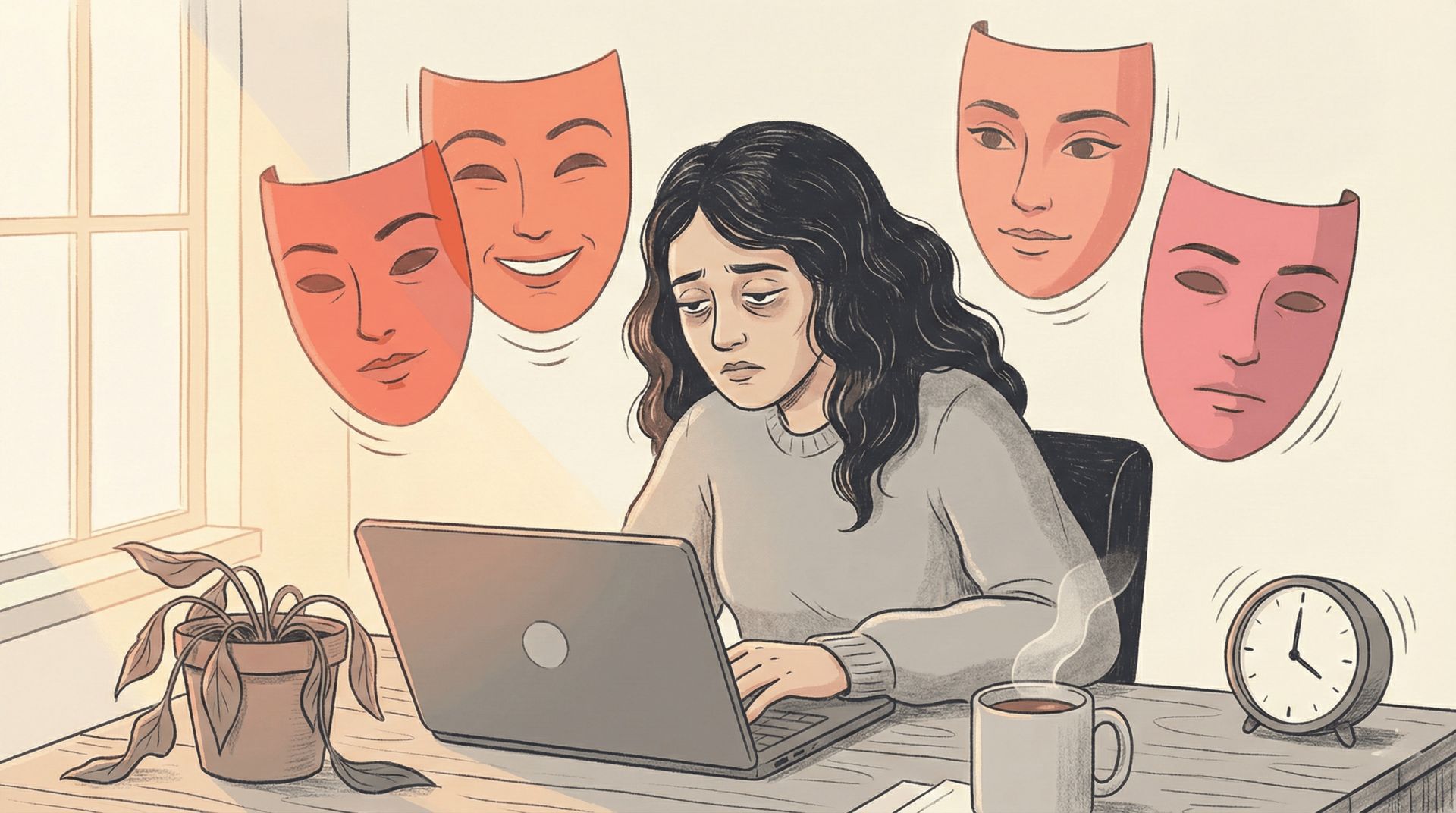
What Performing Fine Actually Costs
You know that moment in a meeting when someone asks "How's everyone doing?" and you say "Good!" even though your hands are shaking?
That's not politeness. That's work you're not getting paid for.
Here's what "performing fine" actually requires:
Monitoring your tone in every Slack message so nobody thinks you're struggling
Keeping your camera on even when you're dissociating
Responding "No problem!" when you're asked to do one more thing
Pretending your bandwidth is infinite when it ran out three days ago
Crafting the perfect "I'm busy but not too busy" calendar aesthetic
By the time you're done performing, you have nothing left for the actual work.
The truth nobody talks about: You're not protecting anyone. You're just spending capacity you don't have on a lie nobody asked for.
The performance doesn't make you more professional. It makes you more exhausted.
And the team? They're doing the exact same math - burning energy on appearing fine instead of admitting they're at 40% and figuring out how to work with that reality.
Why It Matters
This isn't about being more authentic or vulnerable or any other LinkedIn buzzword.
This is about basic operational reality.
When everyone on your team is performing fine, here's what actually breaks:
Trust disappears. You can't build psychological safety in a culture where "I don't know" feels like confession. If curiosity is risky, collaboration becomes performance art.
Problems stay hidden. That thing that's been broken for weeks? Nobody mentions it because admitting you noticed means admitting you couldn't fix it alone. So it stays broken while everyone pretends they haven't seen it.
Burnout becomes contagious. You see your teammate responding to Slack at 11pm and think "guess that's the standard now." They're doing it because they saw you do it last week. Nobody's okay. Everyone's performing. The bar keeps rising.
Innovation dies. Breakthrough ideas don't come from people operating at 100% polished capacity. They come from messy experiments, half-baked questions, and "what if we tried something weird?" Those conversations don't happen when everyone's busy proving they're fine.
Remote work was supposed to give us flexibility. Instead, we built invisible prisons where the performance never stops because nobody can see when you finally collapse.
So what happens when you stop performing? Does everything fall apart? Does your team lose respect for you?
No. The opposite happens.
When one person drops the mask, everyone else gets permission to breathe. When you say "I'm at 60% today and here's what I can actually do," you're not failing - you're modeling the thing that makes remote teams actually work.
What if the performance is the only thing breaking your team? What if stopping is what saves it?


🎁 GOING DEEPER: PREMIUM UNLOCKED
As the community evolved, some of you asked for more. More practice. More peer exchange. More accountability.

So we built Premium Membership — not for everyone, but for those ready to go from consuming to creating together.
What Premium unlocks:
🎯 Collaborative challenges like the (R) Challenge — structured sprints to turn ideas into outcomes
👑 Peer exchange & mentoring with people who genuinely understand remote work
💎 Curated resources & tool perks, including exclusive Miro discounts and early access to new formats
Not sure if it's for you? Reply to this email. It goes straight to Marion Zoé, and she'll help you figure it out. No pressure, no BS.

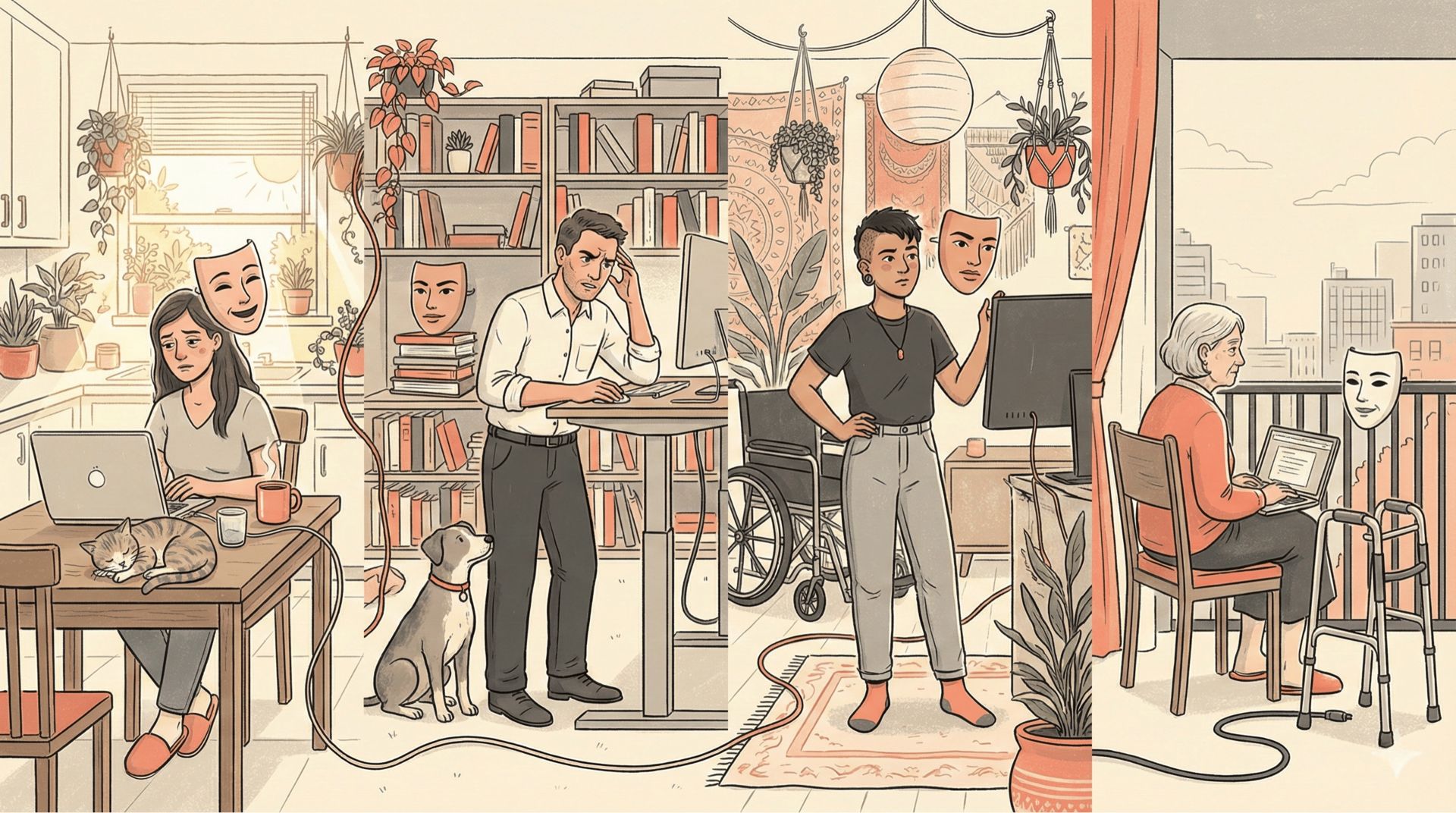
How Each Generation Feels It
Gen Z: You learned to perform "professional" before you learned what actually works for you. Every Slack message gets edited three times. Every camera-on moment feels like a test. You were told remote work means flexibility, but it feels like constant surveillance. The performance is exhausting, but you're not sure what happens if you stop. What if admitting you're struggling means you're not cut out for this?
Millennials: You were raised on "fake it til you make it." Now you're trapped between wanting to model vulnerability for younger teammates and feeling like you need to prove you've got it together. You're juggling work, maybe kids, maybe aging parents, definitely burnout. But saying "I can't" feels like failure. So you keep saying "no problem" while your capacity quietly implodes.
Gen X: You were taught that competence means never admitting you're overwhelmed. So you spent years performing fine before you even realized that's what you were doing. Burnout wasn't a word people used - it was just "handling it." Remote work was supposed to be easier. Instead, it just made the performance 24/7. No closed office door. No drive home to decompress. Just an endless loop of proving you've got it together when honestly, you're not sure you ever did.
Boomers: You built careers on loyalty and face time - showing up meant being seen. Remote work removed the visibility you relied on to prove your value. Now you're performing "still relevant" on top of everything else. Admitting you're tired or need help feels like admitting you're ready to retire when you're not. The performance isn't about tech - it's about proving you still belong when all the old markers of belonging disappeared.
Different generations. Same exhaustion: We're all burning capacity on a performance nobody asked for.
Fixes: Stop Performing, Start Functioning
You can't wait for your company to fix this. Start small. Start weird. Start now.
The Interpersonal Stuff
Name your actual capacity. "I'm at about 60% today - here's what I can handle." Most people respect honesty more than they'd respect you burning out quietly.
When someone admits they're struggling, don't fix it. Just say "thanks for telling me" or "what would actually help?" Resist the urge to perform solutions.
If your manager is performing fine, name what you need anyway. "I need to work async today" or "I'm protecting focus time this week" - you don't need their permission to function differently.
Find one person who's real. You don't need your whole team to drop the performance. You just need one person who will say "yeah, me too."
The Boundary Stuff
Block 'reset hours' with zero explanation required. Put it on your calendar. Don't justify it.
Practice saying "I don't have capacity for that" without the follow-up justification. Period. Full stop. Done.
Stop responding immediately to everything. Urgency is contagious but usually fake. Wait 20 minutes. See if the world actually burns.
The Team/Culture Stuff
Make "not okay" visible. Slack status: "Low bandwidth mode" or "Slow responses today." Give people data instead of making them guess.
Put "mental health day" on your actual calendar using real words. Not "appointment." Model it.
Institute "No Stupid Questions" time blocks. Literally put it on the calendar. 15 minutes. Once a week. Anyone can ask anything. No performance required.
The Practical Stuff
Use AI to hold the performance load. "Help me write a kind message that says I can't take this on." Let AI handle the polish.
When you can't show up fully for a meeting, say so at the start. "I'm here but not at 100% today." Then participate at the level you actually have.
Stop editing Slack messages to death. Three drafts is a performance. Send it human. Typos included.

💛 Miro Engage: See It. Learn It. Use It.
Wednesday, January 21, 2026
5:30 AM CST | 11:30 AM GMT | 12:30 PM CET | 5:00 PM IST | 7:30 PM SGT
With Jakob Knutzen (former Butter founder, now workshop expert at Miro) and Christopher Holm-Hansen (Miro product team)
The official launch of Miro Engage. Jakob and Christopher unveil the final version, walk through real use cases, share the honest V1 roadmap, and tackle your engagement challenges live.
Why show up: Because remote workshops still suck, and this is the team that might actually fix it. Plus, get prepped for the February 15th Miro Engage Challenge.
Who this is for: Workshop facilitators, remote team leads, early adopters, community builders.
🔒 Members-only event - Free registration gets you Hub access.

AI Prompt of the Week
Role: You are a workplace culture consultant specializing in psychological safety and remote collaboration.
Objective: Help me design a low-stakes, playful system that makes not being okay feel safe and normal on my remote team.
Context: I work on a [insert: fully remote / hybrid / distributed] team of [insert: size and roles, e.g., "6 people in product and design"]. Right now, people tend to [insert: your team's pattern - "stay silent when struggling" / "only admit problems in 1:1s" / "perform fine in meetings" / "ask AI instead of teammates"]. I want to normalize admitting reduced capacity without it feeling heavy, formal, or like we're turning into a therapy session.
Output: Give me 5 specific, actionable strategies to normalize "not okay" on my team. Make them:
Grounded in research on psychological safety or adult learning
Playful and energizing (not performative or corporate)
Realistic to implement in the next two weeks
Include at least one strategy that feels delightfully weird but still possible
For each strategy, include: what it is, why it works, and one concrete example of how to launch it.
Role: You are a workplace culture consultant specializing in psychological safety and remote collaboration.

Objective: Help me design a low-stakes, playful system that makes not being okay feel safe and normal on my remote team.

Context: I work on a [insert: fully remote / hybrid / distributed] team of [insert: size and roles, e.g., "6 people in product and design"]. Right now, people tend to [insert: your team's pattern - "stay silent when struggling" / "only admit problems in 1:1s" / "perform fine in meetings" / "ask AI instead of teammates"]. I want to normalize admitting reduced capacity without it feeling heavy, formal, or like we're turning into a therapy session.

Output: Give me 5 specific, actionable strategies to normalize "not okay" on my team. Make them:

1) Grounded in research on psychological safety or adult learning
2) Playful and energizing (not performative or corporate)
3) Realistic to implement in the next two weeks
4) Include at least one strategy that feels delightfully weird but still possible

For each strategy, include: what it is, why it works, and one concrete example of how to launch it.
Your Turn
What's one way you've stopped performing fine at work? Or confess: what's the performance costing you right now that nobody sees?
Reply to this email or share in the Community. The best ones might show up in a future Expresso.
Closing Transmission
The best teams aren't the ones with all the answers.
They're the ones where someone can say "I'm not okay" and three other people admit "Yeah, me too."
The performance doesn't make you more professional. It makes you more isolated.
So this week, try dropping it. Just once. In one meeting. With one person.
Say "I'm at 60% today" or "I don't have bandwidth for that" or "honestly, I'm struggling."
Not because it's brave. Because it's true.
And the team? They're probably spending the same energy pretending they're fine. Your honesty might be the thing that lets everyone else breathe.
Corporate polish is overrated. But honest capacity management? That's how teams actually survive.
— The (R) Generation Team 🧡 🫶🏻
PS: If no one's told you today - performing fine when you're not is costing you more than the honesty ever would. Drop the mask. Reclaim the energy.

👨💻 Big Desk Energy: our biggest startup insights, & stories
✈️ Nomad Cloud: get the latest on remote work and location independence.
🌎 Thrive Remotely: lifestyle and wellness for remote workers
🦄 Mostly Human: midlife women getting creative with AI
👩🎤 Customer Success Jobs: our remote high-paying jobs for you
🤖 Americans Abroad: insights about visas, residency, & cost of living
🔴 Creator Spotlight: inspiration for world class creators journeys

BE A PART OF
THE R GENERATION COMMUNITY

 JOIN A GLOBAL COMMUNITYConnect with 7,000+ remote professionals, creators, |  ACCESS |  ACCELERATE |
R GENERATION brings together remote professionals from 50+ countries to explore the future of work through events, workshops, and AI-powered collaboration. Join a community where curiosity meets innovation and connections transcend borders.
Join us where your ideas spark innovation, your curiosity fuels learning, and your ambition shapes the future of remote collaboration.

What did you think of this issue?BE REAL. We love hearing from you! |

 |
|

That moment you stop performing and realize the world didn't end
Reply