- R GENERATION
- Posts
- ☕️ (R)emote Expresso #62
☕️ (R)emote Expresso #62
Stop Optimizing. Start Experimenting.

Deb Haas
February 10, 2026 • ⏰ Reading Time: 17 minutes
☕️ (R)emote Expresso is your weekly dose of creator insights on remote collaboration designed to fuel your day, delivered once a week in your inbox 💌

Hey Remote Rebels and Digital Daydreamers,
You know that thing you've been tweaking for three months?
The meeting format. The project template. The way you organize your day.
You keep making it better. Small improvements. Incremental gains.
And somehow it still feels... off.
That's optimization. You're assuming you're close to right and just need better execution.
Here's the truth: optimization drains you because the bar keeps moving. Every improvement reveals another problem. Every fix creates new friction.
Experimentation works differently.
It assumes you might be completely wrong about how this should work. And instead of trying to perfect the current approach, you just... try something else and see what happens.
The bar isn't "did I make it better?" It's "did I learn anything?"
One makes you cautious. The other makes you curious.

Why Optimization Is Exhausting (And Experimentation Isn't)
Optimization starts with: "How do I make this 10% better?"
Experimentation starts with: "What if I tried something completely different?"
When you optimize:
You're carrying the weight of getting it right
Success means measurable improvement
Failure means you wasted time and lost credibility
The bar keeps rising (today's improvement becomes tomorrow's baseline)
When you experiment:
You're trying to see what happens
Success means you learned something
Failure means you got data
The bar is "did I notice what changed?"
Here's the energy difference:
You spend three weeks redesigning your team's standup format. You research best practices. You pilot it. You gather feedback. You refine it.
It's 15% better. Maybe. Hard to tell. And now you're responsible for maintaining it.
That's optimization. The return barely covers the investment.
You spend 15 minutes trying standups in a different tool just to see if the format was the problem or the medium was. Turns out the tool wasn't the issue - but you noticed people engaged more when you started with a question instead of updates.
That's experimentation. Low investment. Clear signal. You use what you learned and move on.
One assumes you're close to the answer and need better execution. The other assumes you might be asking the wrong question.
And right now - February, six weeks in, patterns visible - you don't need better execution. You need better questions.

The February Permission Slip
You've had six weeks.
Six weeks to see what's actually working. What you said you'd do versus what you're actually doing. Which systems held up and which ones collapsed by week two.
January is promises. February is data.
And here's what the data probably shows: some things are working fine. Some things need minor adjustments. And some things - the ones you keep trying to fix - might just need to be completely different.
This is the moment to pivot.
Not because everything's broken. Not because you failed. Because you have actual information now about what needs to change.
The thing you've been optimizing since November? The meeting cadence that still feels off? The project management system that nobody actually uses the way you designed it?
February is when you get to stop perfecting it and try something else.
Here's your permission slip: You're allowed to abandon the thing you've been trying to make work.
Not forever. Not dramatically. Just for one week. Just to see what happens when you stop trying to fix it and start from scratch.
The optimization mindset says: "I'm so close. One more tweak and it'll click."
The experimentation mindset says: "I've been tweaking this for months. What if I just tried something completely different?"
February gives you cover. You're not giving up. You're using the data you collected in January to make a smarter bet.
So pick one thing you've been trying to perfect. And this week, try doing it wrong on purpose. See what breaks. See what doesn't.
That's not failure. That's learning.

What Experimentation Actually Looks Like
Not a framework. Not a process. Just: here are things you could try this week that might teach you something.
Flip your meeting order. You always start with updates and end with discussion? Reverse it. Start with the hardest question first. See if people show up differently when they know they can't just recite status.
Kill one recurring meeting for a week. Not the important one. The one you keep having because it's on the calendar. Cancel it. See if anyone notices. See what happens to the work that meeting was supposed to protect.
Use a completely different tool. You've been optimizing your Notion setup for months? Try doing the same work in a Google Doc for three days. Not because Docs is better - because the constraints might show you what actually matters.
Change your working hours by two hours. Start at 6am instead of 8am. Or 10am instead of 8am. Just for this week. See which meetings you actually miss and which ones were filling time.
Ask the question you're not supposed to ask. In your next team meeting: "What are we doing that we could just stop?" See what people say when you give them permission to name it.
Do the thing badly on purpose. That report you polish for three hours? Send the rough draft. That presentation you rehearse five times? Wing it. See if anyone cares as much as you think they will.
Run a workshop with zero slides. You always build a deck? Try facilitating with just a Miro board and voice. See if the lack of polish changes how people engage.
Facilitate a session in someone else's timezone. If you always run workshops at your convenient time, try 6am or 10pm for you. See how your energy shifts. See who shows up differently.
Design something in 15 minutes that you'd normally spend 3 hours on. Not to ship it. To see what you prioritize when you can't polish.
Share work-in-progress instead of finished work. Post the messy wireframe. The half-baked concept. The thinking-out-loud sketch. See what feedback you get when people can actually influence the direction.
Use voice notes instead of Slack messages for a day. Record your updates instead of typing them. See if the medium changes what you say and how people respond.
Invite someone random to your team meeting. Not a stakeholder. Just someone from the community who's curious. See what you explain differently when a stranger is watching.
Prototype in the opposite direction. If you usually start high-fidelity, start with paper. If you usually start lo-fi, jump straight to polished. See what you skip and what you notice.
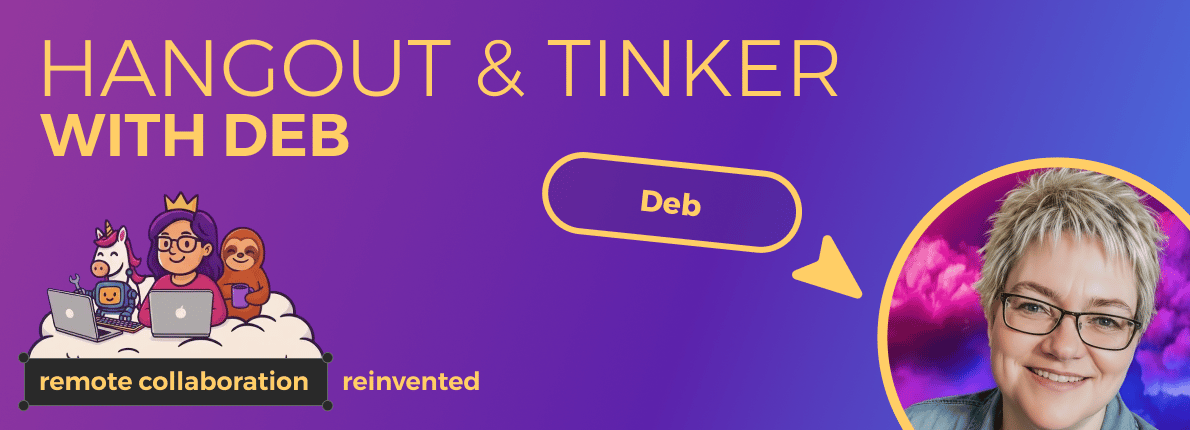
Join Hangout & Tinker. Show up unprepared. Try something you've been curious about but had no "work reason" to learn. February 11, bi-weekly from there. Low stakes. No agenda. Just: what happens when you give yourself permission to mess around?
These aren't improvements. They're experiments. The goal isn't to make things better. The goal is to see what you learn.

Have camera, lappy, and too many AI tools
Hangout & Tinker with Deb
Speaking of experiments…
I'm starting something. Bi-weekly coworking sessions where you can try tools, ideas, and things you've been curious about but had no "work reason" to learn.
No agenda. No deliverables. No pressure to show up with a plan. No pressure to stay the whole time.
Drop in for 20 minutes. Stay for two hours. Leave when you're done.
Just: what happens when you give yourself permission to mess around with something that might teach you nothing?
Maybe you want to try building an AI prompt you've been thinking about. Maybe you're curious about a Miro template. Maybe you just want to be in a room with other people who are figuring things out in real time without pretending they have it together.
This isn't a workshop. It's not a masterclass. It's the remote work version of staying after class to mess around in the art room.
Why I'm doing this: Because waiting for the "right" training or the "perfect" moment to learn something means you never actually learn it. You just collect bookmarks.
Who it's for: Anyone tired of optimizing their workflow and ready to just try something.
When: Starting February 11, 9:00 AM - 11:00 PM CST. Bi-weekly from there. Come for whatever part works.
I have no idea if this will work. But I'm done optimizing the idea. Time to try it.

AI Prompt of the Week
Role: You are a workplace consultant specializing in experimentation, learning design, and helping people break patterns that aren't working.
Objective: Help me identify one thing I've been optimizing that might need experimentation instead, and design a low-stakes experiment I can run this week.
Context: I work in a [insert: fully remote / hybrid / distributed] environment as a [insert: role]. There's something I keep trying to make better - [insert: the thing you've been tweaking - meeting format, workflow, tool setup, communication pattern, etc.]. I've been working on it for [insert: timeframe], and it still feels off. I want to try something completely different instead of making another incremental improvement.
Output: Give me:
A clear diagnosis of why optimization might not be working here (what am I assuming that might be wrong?)
One specific experiment I can run this week that tests a different approach entirely
What to watch for - what signals will tell me if this direction is worth exploring?
How to decide whether to keep going, pivot again, or go back to the original approach
Make the experiment:
Low-risk (won't blow up my work or team)
Concrete (I know exactly what to do tomorrow)
Time-boxed (one week maximum)
Focused on learning, not proving I'm right
You are a workplace consultant specializing in experimentation, learning design, and helping people break patterns that aren't working. Help me identify one thing I've been optimizing that might need experimentation instead, and design a low-stakes experiment I can run this week. I work in a [insert: fully remote / hybrid / distributed] environment as a [insert: role]. There's something I keep trying to make better - [insert: the thing you've been tweaking - meeting format, workflow, tool setup, communication pattern, etc.]. I've been working on it for [insert: timeframe], and it still feels off. I want to try something completely different instead of making another incremental improvement.

Give me:
1. A clear diagnosis of why optimization might not be working here (what am I assuming that might be wrong?)
2. One specific experiment I can run this week that tests a different approach entirely
3. What to watch for - what signals will tell me if this direction is worth exploring?
4. How to decide whether to keep going, pivot again, or go back to the original approach

Make the experiment:

- Low-risk (won't blow up my work or team)
- Concrete (I know exactly what to do tomorrow)
- Time-boxed (one week maximum)
- Focused on learning, not proving I'm right
Closing: The Lab Report You'll Never Write
Most experiments don't get documented.
You try something. You notice what happens. You quietly adjust based on what you learned.
No formal writeup. No retrospective. No presentation to leadership about your findings.
You use the information and move on.
Learning works this way outside of school.
The meeting you flipped? If it worked better, you keep doing it that way. If it didn't, you try something else next week. Either way, you know more than you did on Monday.
The tool you switched to? If it revealed something about your workflow, great. If it confirmed the original tool was fine, also great. You're not writing a migration plan - you're less confused about what matters.
The question you weren't supposed to ask? If it opened something up, you ask it again. If it landed flat, you learned where the boundary actually is.
Optimization demands proof. Experimentation demands noticing.
So this week: try one thing wrong. See what it teaches you. Don't write it down unless you want to.
The data lives in what you do next.
— The (R) Generation Team 🧡 🫶🏻
PS: February is the month for trying things that might not work. Welcome to the lab.

👨💻 Big Desk Energy: our biggest startup insights, & stories
✈️ Nomad Cloud: get the latest on remote work and location independence.
🌎 Thrive Remotely: lifestyle and wellness for remote workers
🦄 Mostly Human: midlife women getting creative with AI
👩🎤 Customer Success Jobs: our remote high-paying jobs for you
🤖 Americans Abroad: insights about visas, residency, & cost of living
🔴 Creator Spotlight: inspiration for world class creators journeys

BE A PART OF
THE R GENERATION COMMUNITY

 JOIN A GLOBAL COMMUNITYConnect with 7,000+ remote professionals, creators, |  ACCESS |  ACCELERATE |
R GENERATION brings together remote professionals from 50+ countries to explore the future of work through events, workshops, and AI-powered collaboration. Join a community where curiosity meets innovation and connections transcend borders.
Join us where experimentation beats perfection, curiosity beats caution, and trying things wrong on purpose counts as progress.

What did you think of this issue?BE REAL. We love hearing from you! |

 |
|

February experimentation status
Reply