- R GENERATION
- Posts
- ☕️ (R)emote Expresso #63
☕️ (R)emote Expresso #63
The Visibility Tax: Who Decided Silence Was Failure?

Deb Haas
February 17, 2026 • ⏰ Reading Time: 16 minutes
☕️ (R)emote Expresso is your weekly dose of creator insights on remote collaboration designed to fuel your day, delivered once a week in your inbox 💌

Hey Remote Rebels and Digital Daydreamers,
You know that tab you have open right now?
Not the one you're working in. The other one. The one that's been sitting there since Thursday because you opened it, read half a sentence, and then went back to doing the invisible work of keeping everything running.
That tab is you.
Open. Present. Doing real work. Completely off everyone's radar because you're not narrating your output in Slack for an audience.
Nobody gave you a reaction emoji. Nobody said "great point." You didn't post about it. So as far as the algorithm of modern work is concerned, it didn't happen.
This week, we're not talking about how to be more visible.
We're asking who built the system that charges you for being quiet.

Welcome to the Visibility Olympics
The Milan-Cortina Winter Games are happening now. Athletes from 90+ countries. Years of training. The best in the world, competing on the world's biggest stage.
And somewhere in a Slack channel near you, Derek is doing the same thing.
Derek posts his updates before the standup starts. Derek replies to things in under four minutes. Derek reacts to every announcement with 🙌 and follows it up with "Love this direction." Derek has never once mentioned what he actually did last week, but his name is everywhere, and somehow he got a shoutout in the all-hands.
Derek is not the problem. Derek learned the rules.
The problem is that we're all in a competition nobody agreed to enter.
Remote work sold us freedom from the performative theater of the open office. No more hovering near the boss's desk. No more "face time." And then we rebuilt the entire thing in Slack and LinkedIn and camera-on Zoom calls, and called it culture.
The events have changed. The scoring system hasn't.
In the Visibility Olympics, the medals go to:
🥇 First to post the update
🥈 Most reactions on the team channel
🥉 Loudest presence in a meeting nobody needed
Quiet, focused, excellent work? That's not even a sport.

Who Built This System and Who Pays
Let's be honest about where this came from.
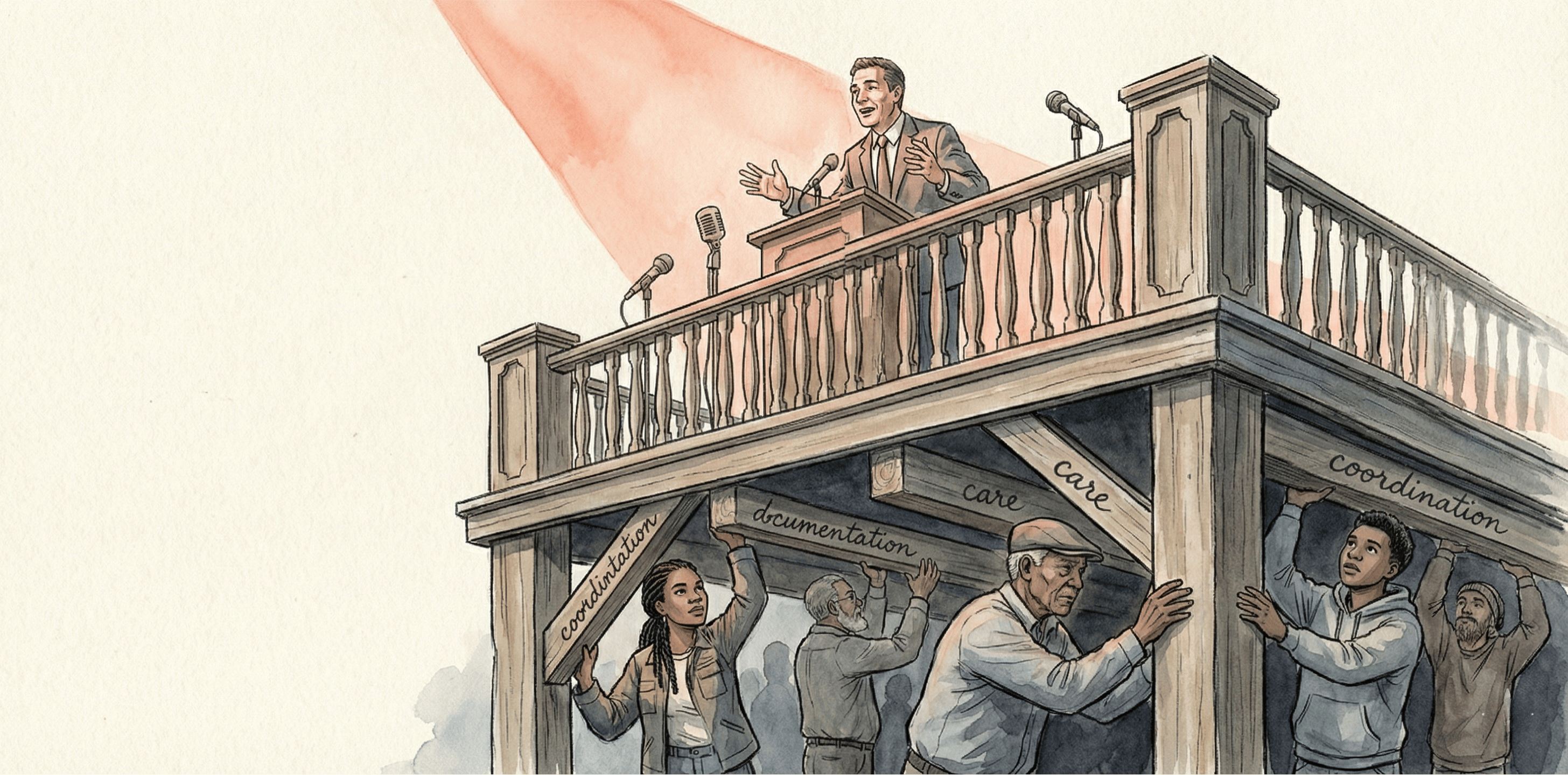
The visibility-as-value myth wasn't invented by remote work. It was imported from offices where managers measured presence because they didn't know how to measure output. If they could see you, you were working. If they couldn't, you weren't. It was lazy. It was also everywhere.
Remote work didn't fix that. It just moved the surveillance to a smaller screen.
Now presence looks like response time. Status indicators. Camera policies. Posting in the channel. Being "on" in ways that are visible, trackable, and easy to mistake for contribution.
This system works great if you're the person it was built for.
It disadvantages people who are caregiving between meetings. People whose communication style is considered, not instant. People with anxiety who rehearse before they speak. People who are newer to a language or a culture and need a beat before they respond. Neurodivergent people whose brains do extraordinary work that doesn't always announce itself.
It rewards people who are comfortable performing. It taxes everyone else.
The visibility tax is real. It shows up as the exhaustion of code-switching into "present enough." The mental overhead of deciding whether to post something or stay quiet. The slow erosion of confidence that happens when excellent work goes unwitnessed.
You're not bad at your job. You're paying a toll that was never yours to owe.
The Lurker's Bingo Card
You know who you are.
You read everything. You track the conversation. You form a considered opinion and then decide the thread has moved on and your point would be redundant now anyway. You have drafted and deleted more Slack messages than you've sent. You attended the meeting, absorbed everything, contributed once, and left feeling like you'd somehow failed a test you didn't know you were taking.
Welcome to the Lurker's Bingo Card. Dab accordingly.
⬜ Typed a response, reread it three times, deleted it
⬜ Knew the answer but someone else said it first
⬜ Got credited for work in a meeting you weren't in
⬜ Described yourself as "more of a listener" to avoid explaining the rest
⬜ Felt guilty for not posting in a channel you check daily
⬜ Had a brilliant idea at 11pm and decided it could wait
⬜ "Liked" something instead of replying because a reply felt like too much
⬜ Prepared a comment for a meeting and the agenda moved before you could use it
⬜ Done your best work completely alone, with zero witnesses
If you got five or more: you're not disengaged. You're not checked out. You're not "hard to read."
You're just not performing. And someone built a system that confused those two things.

The Uncomfortable Counter-Truth: Deb's Story
I got my ADHD diagnosis on Christmas Eve 2024.
I remember sitting in the psychologist's office nodding along. I remember her explaining the results. Scrawled numbers and lines. She told me my processing speed was off the charts. Ferrari brain, she said. And then she pointed to the other numbers.
Executive Function Deficits.
Those three words started echoing somewhere in the middle of that appointment and I honestly can't tell you what she said after that. I nodded. I probably said thank you. I drove home and I have no memory of the ride.
The first thing I did when I got through the door was ask an AI to explain what those three words meant in language I could actually hold. To give me analogies. To help me understand what this meant for my actual life.
And then my brain started paging through memories.
Taking notes in a meeting. Trying to participate in the conversation at the same time. Remembering halfway through that I was supposed to be taking notes. Trying to figure out what was most important to write down versus what the people reading it would consider most important. What nuances was I missing. All of that, simultaneously, every single meeting, for years.
Meetings where I fumbled. Conversations I derailed. Deadlines I missed.
The shame was bone-deep.
I had been through a leave of absence the year before. Depression, anxiety, suicidal ideation. I had spent that year building the muscle of feeling things instead of outrunning them. So I knew what to do. I let the shame in. All of it. I told myself I could share the diagnosis but not the deficits part. Too much. Too raw.
Then I rewatched Twilight.
All of it.
Then I told myself to sleep on it.
Christmas morning I posted the whole thing. The diagnosis. The deficits. The embarrassment. The loop of memories. The part about not feeling like enough.
The people who reached out weren't the loud ones. They were the ones who recognized the shame. Who had their own version of those three words echoing on a drive home. Who had been editing themselves down for years, deciding what was safe to share and what needed to stay hidden.
Visibility isn't just about being seen for your work. Sometimes it's about being seen at all.
That's what the tax actually costs.

The Minimum Viable Visibility Menu
Nobody is asking you to become Derek.
But complete invisibility has a cost too, and you already know what it is. You've felt it. The slow erosion of being overlooked for things you were qualified for. The exhaustion of doing excellent work that nobody can point to.
So this isn't about performing more. It's about spending less energy on hiding.
Pick one. Try it for a week.
The Receipt: After you finish something, post one sentence about it. Not a celebration. Not a thread. One sentence. "Finished the audit. Took longer than expected but the numbers are clean." That's it. You did the work. Leave a trace.
The Quiet Co-sign: Find someone else's good work and name it specifically. "This is exactly the kind of thinking we need more of." Not a reaction emoji. An actual sentence. Visibility is sometimes about making other people visible. It builds the muscle without the spotlight.
The Process Drop: Share something you're figuring out, not something you've already solved. "Still working through how to structure this. Anyone dealt with something similar?" It's not vulnerability theater. It's an invitation. And it signals presence without requiring a finished product.
The Occasional Unmute: Pick one meeting a week where you say the thing you would normally edit out. Not every meeting. One. The considered opinion you usually keep to yourself because someone else might say it first. Say it anyway.
The Async Footprint: Leave a comment in a document. Respond to a thread two days late with something worth reading. Visibility doesn't require real time. It just requires showing up somewhere people can find you.
Small. Doable. None of them require you to become someone you're not.

AI Prompt: Your Visibility Audit
Before you can figure out where you want to show up, it helps to understand where you already are and what it's actually costing you.
This prompt uses the ROCO framework: Role, Objective, Context, Output.
The Prompt:

Act as a workplace culture coach who specializes in remote work and helping people find sustainable ways to show up professionally without burning out on performance.

I want to audit my current visibility at work and figure out what's draining me versus what might actually feel sustainable.

Here's my context: I am a [remote worker / freelancer / team lead / etc.] who tends to [describe your style: lurk, observe, contribute quietly, avoid self-promotion, etc.]. I work in [describe your environment: async, always-on, meeting-heavy, Slack-first, etc.]. The part that costs me the most energy is [name it: performing presence, responding quickly, being on camera, posting updates, etc.].

Based on this, give me:
1. A honest assessment of what the visibility tax is actually costing me specifically
2. Three minimum viable visibility moves that fit my style and don't require me to perform
3. One strategy that feels unconventional or slightly weird but is still completely doable
4. One thing I can stop doing immediately because it's performance with no real return
Why this works:
Most visibility advice assumes you want more of it. This prompt starts from where you actually are. The last two outputs are the ones worth paying attention to. The weird strategy is usually the one that fits you best. And the thing to stop doing? That's the tax refund.

The Room Needs You In It
Not the performed version of you. Not the version that responds in under four minutes and reacts to everything with 🙌 and has figured out how to make silence look like engagement.
The actual you.
The one with the tab open since Thursday. The one who typed and deleted. The one who knew the answer and waited too long to say it. The one who did extraordinary work this week that nobody saw.
That person is not failing at visibility. That person is refusing to pay a tax they never agreed to.
The room is not better when you disappear into it. It's better when you're actually in it, on your own terms, in the smallest sustainable way you can manage right now.
That's enough. It has always been enough.
— The (R) Generation Team 💻 🧡 🫶
PS: Lurking is just listening with commitment. You're welcome here either way.

👨💻 Big Desk Energy: our biggest startup insights, & stories
✈️ Nomad Cloud: get the latest on remote work and location independence.
🌎 Thrive Remotely: lifestyle and wellness for remote workers
🦄 Mostly Human: midlife women getting creative with AI
👩🎤 Customer Success Jobs: our remote high-paying jobs for you
🤖 Americans Abroad: insights about visas, residency, & cost of living
🔴 Creator Spotlight: inspiration for world class creators journeys

BE A PART OF
THE R GENERATION COMMUNITY

 JOIN A GLOBAL COMMUNITYConnect with 7,000+ remote professionals, creators, |  ACCESS |  ACCELERATE |
R GENERATION brings together remote professionals from 50+ countries to explore the future of work through events, workshops, and AI-powered collaboration. Join a community where curiosity meets innovation and connections transcend borders.
Join us where silence isn't failure, excellence doesn't need an audience, and the visibility tax gets refunded.

What did you think of this issue?BE REAL. We love hearing from you! |

 |
|

The lurker who knows everything. Unbothered. Legendary.
Reply